


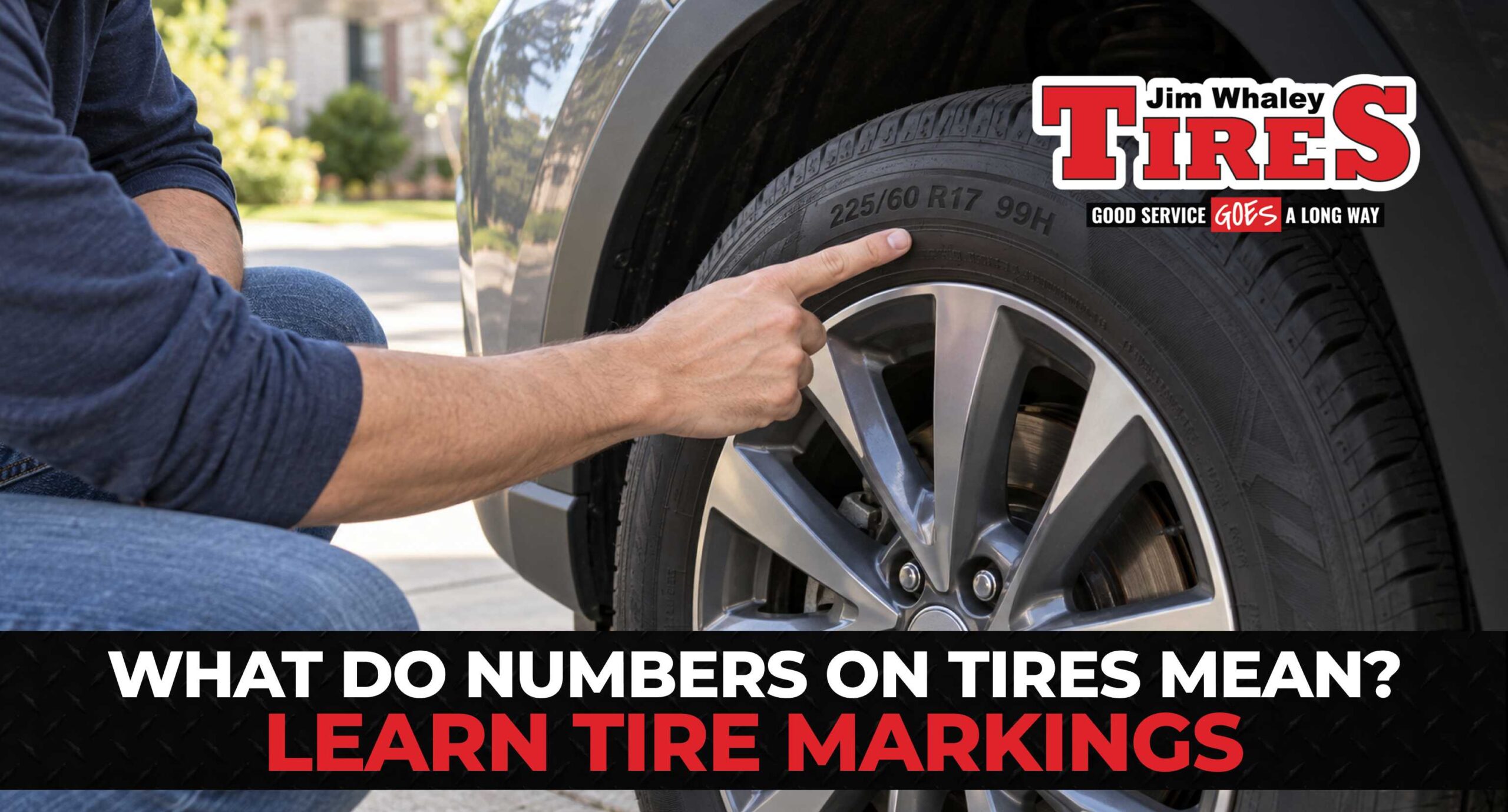
If you’ve ever looked at your tire and wondered what a string like 225/65R17 102H actually means, you’re not alone. Those numbers and letters can look like a code, especially when you’re shopping for replacement tires for the first time.
So, what do numbers on tires mean? They tell you important details such as tire width, sidewall height, wheel size, load capacity, and speed rating. Other markings can tell you when the tire was made, what type of vehicle it suits, and how it should be used.
Knowing how to read your tire sidewall can make tire shopping much easier. It also gives you useful information to discuss with a tire professional before replacing your tires.
TL;DR – What Do Numbers on Tires Mean?
- 225 usually represents the tire’s section width in millimeters.
- 65 represents the aspect ratio, or sidewall height as a percentage of tire width.
- R means the tire uses radial construction.
- 17 represents the wheel diameter in inches.
- 102H gives the tire’s load index and speed rating.
The complete marking can tell you a lot about a tire, but you should always compare it with your vehicle manufacturer’s recommended specifications before buying replacements.
What Do Numbers on Tires Mean Exactly
The easiest way to understand a tire marking is to break it apart.
Let’s use P225/65R17 102H as an example. Each section has a specific purpose, and the information becomes much easier to understand once you read it from left to right.
-
P means passenger vehicle
When a tire begins with P, it generally identifies a tire designed for passenger vehicles.
You may also see other letters or combinations, such as LT, which refers to light-truck applications. The correct tire type depends on your vehicle and the specifications provided by its manufacturer.
Don’t assume that a tire will work simply because the numbers appear similar. The letters at the beginning can affect the tire’s intended application.
-
225 means tire width
The 225 represents the tire’s nominal section width in millimeters.
It measures the tire from one sidewall to the other at the widest point under specified conditions. It does not mean the tread itself measures exactly 225 millimeters.
For example, a tire marked 225 is generally wider than one marked 205. Tire width can influence steering feel, road contact, fuel economy, and tire performance in different conditions.
-
65 means aspect ratio
The 65 is the tire’s aspect ratio.
It means the sidewall height equals approximately 65% of the tire’s section width. With a 225 mm tire, that works out to a nominal sidewall height of about 146 mm.
A lower aspect ratio generally means a shorter sidewall. A higher aspect ratio provides a taller sidewall that can offer additional cushioning over rough pavement.
-
R means radial construction
The R stands for radial construction.
Radial tires use reinforcing cords arranged across the tire’s structure. This construction has become standard on most modern passenger cars, SUVs, and light trucks.
So, when you’re looking at tire size numbers, don’t mistake the R for a rating. It describes construction.
-
17 means wheel diameter
The 17 indicates that the tire is designed to fit a 17-inch wheel.
This number does not mean the complete tire is 17 inches tall. It refers to the diameter of the wheel at the tire’s bead seat.
This distinction matters when you’re shopping for tires. A tire designed for a 17-inch wheel cannot simply be mounted on an 18-inch wheel just because the numbers match.
HONEST SERVICE.
REAL SAVINGS.
CLAIM YOURS AND BOOK
AN APPOINTMENT
VIEW ALL COUPONS
How to Read Tire Size Numbers
Understanding tire size numbers can help you compare replacement options without guessing.
Here’s the basic breakdown of 225/65R17 102H:
- 225 – Section width in millimeters. This tells you the nominal width of the tire from sidewall to sidewall.
- 65 – Aspect ratio. The sidewall height equals 65% of the tire’s section width.
- R – Radial construction. This is the standard construction used on most modern passenger tires.
- 17 – Wheel diameter in inches. The tire is designed to fit a 17-inch wheel.
- 102 – Load index. This is a standardized code for the maximum load the tire can carry under specified conditions.
- H – Speed rating. This letter identifies the tire’s rated speed capability under controlled test conditions.
The key point is that tire size numbers work together. You should not choose a replacement tire based on width alone.
Your vehicle’s recommended tire size should take priority over what is currently installed, particularly if you purchased a used car or SUV. A previous owner may have installed a different size.
What Do the Numbers After the Tire Size Mean
The numbers after the main tire size are easy to overlook, but they matter.
In 225/65R17 102H, the 102 is the load index. The H is the speed rating.
These markings describe the tire’s service capabilities rather than its physical dimensions.
Understanding the tire load index
The tire load index is a numerical code associated with the maximum weight a single tire can carry under specified conditions.
For example, a load index of 102 corresponds to a standardized load capacity of 850 kg, or approximately 1,874 pounds, per tire.
The number itself does not mean 102 pounds or 102 kilograms. It is a code that corresponds to a specific capacity in a standardized load index chart.
That distinction becomes especially important for SUVs, trucks, and vehicles that regularly carry passengers or cargo.
Why the tire load index matters
A tire may physically fit your wheel while still having an unsuitable load rating for your vehicle.
Keep these points in mind:
- Check the manufacturer’s recommendation – Your vehicle placard and owner’s manual provide important tire specifications.
- Consider passenger and cargo weight – A vehicle carrying five people and luggage puts different demands on its tires than one carrying a single driver.
- Do not select a lower rating casually – A lower load capacity can create a safety concern if it falls below the vehicle’s requirements.
- Look at all four tires – Replacement tires should meet the vehicle’s requirements, and mixed specifications can affect handling.
- Ask about heavy-use driving – Frequent hauling, towing, or long-distance driving may affect which tire is appropriate.
The tire load index becomes particularly important when choosing tires for an SUV or pickup. If you’re uncertain, bring the vehicle information to Jim Whaley Tires rather than relying on a visual comparison.
What Does the Letter for Speed Rating Mean
The tire speed rating is represented by a letter, such as H, V, or W.
It indicates the tire’s tested speed capability under specified conditions. It does not mean you should drive at that speed on public roads.
For example, an H-rated tire has a standardized speed rating of 130 mph under the applicable test conditions.
Why tire speed rating matters
The tire speed rating is part of the tire’s overall design and should match the vehicle manufacturer’s recommendations.
Consider these factors:
- Vehicle specifications – Start with the rating recommended by the vehicle manufacturer.
- Handling characteristics – Different tire constructions can affect steering response and handling.
- Heat management – Speed ratings relate to how the tire performs under sustained speed and heat conditions.
- Driving conditions – Highway trips, hot pavement, heavy loads, and long distances can place different demands on tires.
- Replacement consistency – Mixing significantly different tire specifications can affect the vehicle’s handling.
The tire speed rating should never be treated as a target driving speed. Think of it as one part of the tire’s engineering specification.
What Other Tire Sidewall Markings Should You Know
The size code gets most of the attention, but there are several other tire sidewall markings worth knowing.
These markings can help you identify the tire’s age, intended use, and other characteristics.
-
DOT code
A DOT marking identifies information associated with the tire’s manufacture and compliance.
The final digits of the DOT identification sequence can tell you the week and year the tire was manufactured. For example, a code ending in 2526 indicates production during the 25th week of 2026.
The manufacturing date can help when you’re evaluating an older tire, especially if a vehicle has low mileage but its tires have been installed for several years.
-
M+S marking
You may see M+S, which means Mud and Snow.
This marking indicates that the tire meets the relevant criteria for that designation. It should not automatically be treated as equivalent to a severe-snow-service tire.
-
Three-Peak Mountain Snowflake
The three-peak mountain snowflake symbol identifies tires that meet specific performance requirements for severe snow conditions.
Drivers who regularly deal with significant winter weather should understand the difference between this symbol and an M+S marking.
-
XL marking
Some tires have XL, meaning Extra Load.
An XL tire has a higher load capacity than a standard-load tire of the same size when operated at the applicable inflation pressure.
That doesn’t mean XL automatically makes a tire better for every vehicle. The correct choice depends on the vehicle manufacturer’s specifications.
-
Rotation and mounting markings
Some tires have directional arrows or markings indicating the correct rotation direction.
Others have markings such as OUTSIDE or INSIDE for asymmetric tires.
These details matter during installation. Incorrect mounting can affect how the tire performs.
Once you understand these tire sidewall markings, the sidewall becomes a useful reference when you’re checking your tires.
Where Can You Find the Correct Tire Size for Your Car
Your current tire is one place to look, but it should not be your only reference.
The vehicle manufacturer’s recommended tire information is usually found on a sticker inside the driver’s door area. You can also check the owner’s manual.
This is especially useful if you’re buying a used vehicle.
Follow these steps:
- Open the driver’s door – Look around the doorjamb or doorframe for the tire information placard.
- Write down the recommended size – Record the complete marking rather than only the first number.
- Check the load and speed ratings – These details can be just as important as the dimensions.
- Compare all four tires – Check whether the tires currently installed match the vehicle’s specifications.
- Ask a tire professional if anything differs – A professional can determine whether the existing setup is appropriate.
The tire installed on your vehicle may not always be the correct reference. A previous owner could have changed the tire size, wheel size, or tire type.
Understand Your Tire Numbers With Jim Whaley
Understanding what the numbers on tires mean gives you a useful advantage when it’s time to inspect or replace your tires. You don’t need to memorize every code. Knowing the basic size, load, speed, and manufacturing information can help you ask better questions and avoid choosing a tire based on appearance alone.
A tire professional can also help connect those markings to how you actually use your vehicle. Jim Whaley Tires can check your current tires, compare them with your vehicle’s recommended specifications, and help you determine what makes sense for your driving needs.
If the numbers on your tires still look confusing, you don’t have to figure them out alone. Bring your vehicle to Jim Whaley Tires for a professional tire check and advice based on your vehicle’s specifications.
Schedule your appointment online and get help choosing the right tires for your vehicle.